Weather forecast
- 4.3
- Rating
- 5.00M
- Installs
- Free
- Price
 Analysis by App-foxy
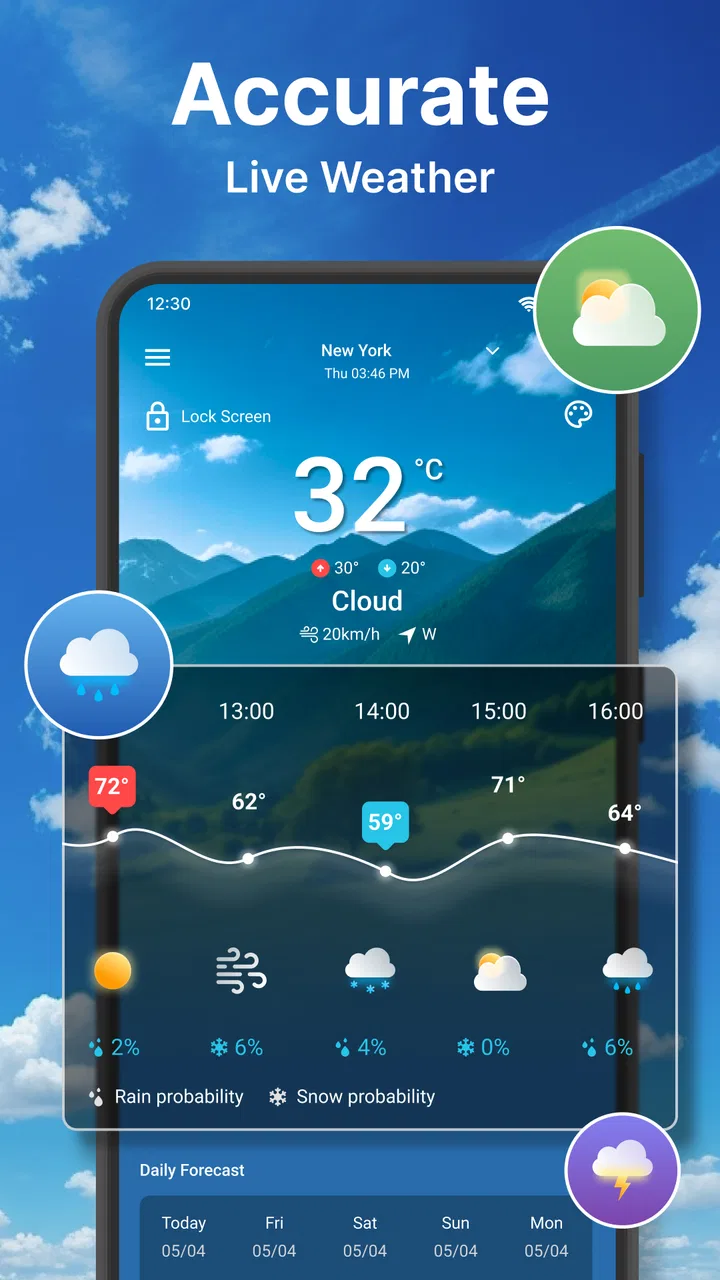
When I check the weather, I usually want an answer quickly: Is it worth walking to work, should I carry an umbrella, and will the temperature change before I get home? Weather forecast is built around that everyday need rather than turning a simple check into a complicated research task. I found it most useful as a practical weather app for current conditions, hourly planning, and a visual look at nearby weather activity.
The app is free and suitable for everyone, which makes it easy to try without treating the decision like a long-term subscription commitment. It comes from Accurate Weather Forecast & Weather Radar Map, a developer whose name makes its purpose very clear. The app has been available since March 14, 2020, and its presence on millions of devices suggests that it has found a broad audience. Its average score of 4.4 from around 37 thousand ratings also gives it a reassuring first impression, although I still think the right choice depends on how you personally use weather information.
How I Decide Whether a Weather App Is Worth Keeping
For me, the first test is not how many screens an app has. It is whether I can open it and understand the immediate situation without sorting through unnecessary detail. A useful weather app should make the current temperature easy to find, show what is likely to happen during the next few hours, and provide enough visual context for changing conditions. Weather forecast handles those priorities directly.
You May Also Like

 Blood Strike: 2.5 Anniversary
Blood Strike’s Loadouts Turn Every Drop Into a Tactical Gamble
A close look at Blood Strike’s custom loadouts: how fast access to signature weapons reshapes its battle royale rhythm, rewards preparation, and narrows the gap between fights.

 Pandora - Music & Podcasts
Pandora’s Music Is Easy to Start, but Harder to Recover
Pandora’s strength is its low-effort path from a seed to a station. Its weak spot is how much confidence it asks you to place in connection, setup, and quiet recovery.

 8 Ball Pool
 Is Built on Rivalries, Rematches, and Routine
A close look at the rivalries, rematches, shared routines, and unanswered safety questions that turn a quick pool match into a persistent mobile community.

 Samsung Music
’s Quiet Strength Is Playing What You Already Own
Its reach comes less from spectacle than from dependable access to a personal library. That simplicity is both the app’s strongest retention engine and its ceiling.

 AccuWeather: Weather Radar
AccuWeather Review: A Quick, Clear Forecast for Everyday Decisions
For everyday plans, the best forecast is the one you can understand quickly. AccuWeather makes rain timing, radar, and local conditions easy to act on, with a few trade-offs.

 Hill Climb Racing
Why Hill Climb Racing Still Turns Crashes Into One More Run
A tiny car, a bumpy hill and one more upgrade: Hill Climb Racing keeps resurfacing because its simple chaos makes every near-miss feel personal.
More From Our News Desk



The second test is planning. A current temperature is helpful when I am already standing at the door, but an hourly view matters more when I am deciding whether to exercise outside, take a longer route, dry clothes outdoors, or schedule a trip across town. I pay attention to whether the forecast supports a decision rather than merely displaying information. In this respect, the hourly presentation is more valuable than a single large temperature reading.
The third test is situational awareness. A regular forecast can tell me what is expected at my location, while a radar view helps me understand whether weather is moving toward me or passing nearby. Those are different questions. I would not use a radar image as a guarantee of what will happen at one exact address, but it is useful when a clear-looking afternoon may be interrupted by a band of rain.
I also consider how much attention an app demands. Some people enjoy detailed charts, extended outlooks, alerts, maps, and layers. Others just want a dependable glance before leaving home. This app is better suited to the second group, especially if the main routine is checking current conditions and the next part of the day.
The first check is fast and practical
On a normal morning, I can use the current conditions as a starting point instead of opening several separate tools. The value is not simply seeing a number; it is having the immediate weather context in the same place as the rest of the forecast experience. That makes the app convenient for quick decisions such as choosing a jacket, delaying a bike ride, or deciding whether a short errand is comfortable on foot.
I particularly like this approach for people who do not want to become amateur meteorologists. The app does not need to replace a specialist weather service to be useful. It only needs to reduce uncertainty at the moments when weather affects a plan. For commuting, school runs, dog walks, casual photography, and weekend errands, that is often enough.
Hourly information is more useful than a distant forecast
A broad forecast can make a day look simple: sunny, cloudy, or rainy. Real plans are rarely that simple. I may have a dry morning, a questionable lunchtime, and a better evening. An hourly view gives me a way to compare those windows instead of treating the whole day as one block.
One practical habit is to check the hourly forecast twice before an outdoor plan: once while making the decision and again shortly before leaving. That second look is especially helpful when the first forecast suggested a narrow dry period. I would not interpret a small change as a failure by the app; short-range weather can shift, and the useful question is whether the updated information changes my plan.
This is also where I see a trade-off. More hourly detail can encourage false precision. A forecast for a particular hour is guidance, not a promise that conditions will change exactly at the displayed time. I use it to choose between options, not to assume that a rain shower will begin or end at a precise minute.
The radar view adds movement and context
The weather radar is the feature I would turn to when the sky and the forecast do not seem to agree. If clouds are building while the current conditions still look comfortable, the map can offer a broader view of what is happening around the area. It is also helpful when I am deciding whether to leave immediately, wait a little, or take a different route.
A useful way to read radar is to look for direction and continuity instead of focusing on one bright patch. A small area of precipitation may pass away from my location, while a larger connected pattern may deserve more caution. I treat the map as a planning aid, not as a replacement for local awareness. Buildings, hills, coastlines, and rapidly developing storms can all make a visual forecast less straightforward.
The radar is also a reason to avoid checking only the current temperature. Temperature tells me how the air feels; radar helps me think about what may arrive next. Together, those views make the app more practical than a basic thermometer-style widget or a single daily icon.
Three workflows that make the app more useful
My first workflow is the “leave now or wait” check. I look at current conditions, move to the hourly forecast, and then use the radar to see whether nearby precipitation appears to be approaching. This takes less effort than opening a general search page, a separate map, and another forecast screen. It is not a guarantee, but it gives me a more informed choice when a short delay could make a walk much easier.
The second is the “protect the outdoor task” workflow. If I need to dry laundry, paint, take photographs, or do garden work, I look for the longest practical stretch of favorable hours rather than choosing the first apparently clear moment. The hourly view helps identify a better window, while the radar provides a reality check if the weather looks unsettled.
The third is the “commute buffer” workflow. I check the forecast before leaving and again before the return journey. Morning conditions can be irrelevant to the trip home, so I do not assume that a comfortable departure means the entire day will stay comfortable. This habit is particularly useful when I am carrying work equipment or when a wet return would be more inconvenient than a slightly longer morning preparation.
The strongest practical idea here is to combine the hourly forecast with radar instead of relying on either view alone. The hourly screen helps with timing; the map helps with movement and surrounding conditions. That combination is more informative than repeatedly refreshing the current temperature.
Who will appreciate this app most
I think Weather forecast is a good fit for people who want a straightforward daily weather companion. It suits commuters, parents planning short trips, casual outdoor users, travelers checking conditions before heading out, and anyone who prefers visual information over reading a dense forecast discussion.
It is also a sensible choice for someone moving away from a phone’s built-in weather panel but who does not want a highly specialized tool. The app offers more context than a minimal glance while remaining focused on ordinary decisions. Since it is free and rated for everyone, it is easy to recommend as a low-risk starting point for a household that wants one shared weather option.
The app may also work well for users who like checking a map during uncertain weather but do not want to study advanced meteorological layers. The radar gives the experience a more active feel: instead of only asking what the weather is, I can look at how conditions appear to be developing around me.
Where another type of weather tool may fit better
I would look elsewhere if my main need were specialist forecasting. Someone planning aviation, marine activity, mountain travel, severe-weather observation, or professional outdoor work may need information designed specifically for that environment. A general weather app can support preparation, but it should not be the only source for decisions where changing conditions carry serious consequences.
I would also compare alternatives if I wanted a very deep long-range planning system. Some weather services focus on extended outlooks, historical patterns, detailed charts, or extensive customization. Weather forecast feels more naturally suited to immediate and near-term decisions. Choosing it for a month-long event plan could be less satisfying than choosing a service built around broader analysis.
There is another important distinction between a dedicated radar service and a general weather app with radar included. A specialist radar product may be preferable for someone who spends much of the day watching storm development. If I only open a radar occasionally before a walk or commute, the broader balance of current conditions, hourly information, and map context is more convenient.
Users who want a highly personalized weather dashboard should also think about their priorities before switching. If you care most about a particular style of widgets, notification controls, data layers, or presentation, the best choice may be the app that matches that workflow rather than the one with the broadest feature list. I would not choose any weather app solely because its store summary sounds complete.
Small frictions I noticed in the decision
The main limitation is that simplicity can feel less satisfying when I want to investigate a complicated weather situation. Current conditions, hourly information, and radar cover common needs, but people who enjoy comparing many forecast models or reading detailed explanations may find the experience less analytical than they prefer.
Radar also requires interpretation. A colorful map can look authoritative, yet it does not remove uncertainty. I still check the sky, local conditions, and the practical consequences of being wrong. For a short walk, that may mean carrying a light rain layer. For a long drive or a serious outdoor activity, I would use additional trusted information.
Another friction is behavioral rather than technical: the app can encourage frequent checking without improving the decision. I get the most value when I define what I need to know first. “Can I walk for twenty minutes?” is a useful question. Refreshing the forecast repeatedly without a plan is not. The app supports good decisions, but it cannot create one automatically.
Because the app is free, I also approach it with realistic expectations. Free access makes trying it easy, but I would still judge the experience by whether it remains comfortable in daily use, not simply by the absence of a purchase. A free app that makes me work harder than a built-in alternative would not be a good bargain in practical terms.
Switching from a built-in weather option
The cost of switching is fairly low for someone who already wants current and hourly weather in one dedicated place. I would begin by using both tools for several days, checking the same location and comparing how quickly each helps me answer ordinary questions. That avoids abandoning a familiar option before knowing whether the new workflow actually feels better.
I would not transfer every weather habit at once. First, I would use the app for the situations that matter most: the morning commute, an outdoor appointment, and a day with uncertain rain. Then I would decide whether the radar adds enough value to justify keeping the app readily available. This trial is more revealing than a single impressive map view.
For a family, the transition is also simple conceptually. Everyone can use the same basic routine: current conditions before leaving, hourly timing for plans, and radar when precipitation is nearby. That shared approach is more useful than having each person interpret a different collection of weather screens.
The main switching cost is learning how much confidence to place in each view. I would avoid treating the hourly forecast as exact scheduling and avoid reading radar as a guarantee. Once that distinction becomes habitual, the app is easier to use responsibly.
My recommendation for everyday use
I recommend Weather forecast to anyone who wants a free, approachable weather app centered on quick checks, hourly planning, and radar context. Its average rating of 4.4 and audience of over five million installs make it a credible option to try, while the Everyone age rating keeps it suitable for a broad range of users.
I would choose it for a daily routine where weather affects practical decisions but does not require professional analysis. It is especially convincing when I need to decide whether to leave now, wait for a better hour, or prepare for weather moving into the area. The app’s best quality is not one isolated screen; it is the way those three perspectives support a simple decision.
I would skip it in favor of a more specialized alternative if I needed advanced forecasting, serious storm monitoring, or deep long-range analysis. I would also stay with a built-in weather tool if all I ever need is a quick temperature glance and I have no interest in hourly or radar context.
For most casual users, though, the balance is sensible. The app does not ask me to learn a complicated weather system before it becomes useful. I can start with the current conditions, add the hourly view when planning, and open the radar only when the situation is uncertain. That gradual approach makes it a practical recommendation rather than merely another weather icon on the phone.
In the end, I see this as a dependable everyday choice for people who want more than a single temperature but less than a professional forecasting workstation. If your weather decisions are mostly about timing, clothing, routes, and nearby rain, this is the kind of focused tool I would suggest trying first.
FAQs for Weather forecast
01What features does the Weather Forecast app offer?
The Weather Forecast app provides real-time updates, including temperature, humidity, and wind speed. It offers detailed hourly and weekly forecasts, severe weather alerts, and radar maps. Users can also access sunrise and sunset times, and the app supports multiple locations for travelers or those monitoring weather conditions in different areas.
02Is the Weather Forecast app free to use?
The app is free to download and offers basic features without any cost. However, there are optional in-app purchases and subscriptions available. These premium features may include ad-free usage, advanced radar maps, and extended forecast data. It's worth checking if the free version meets your needs before considering a purchase.
03How accurate is the Weather Forecast app?
The app sources data from reputable meteorological services and uses advanced algorithms to provide accurate weather predictions. However, like any forecast, it can occasionally be subject to change due to unforeseen atmospheric conditions. Users generally find its predictions reliable, but checking multiple sources for critical weather events is advisable.
04Does the Weather Forecast app require an internet connection?
Yes, the app requires an internet connection to fetch the latest weather data and updates. However, it caches recent data, allowing you to view basic information offline if needed. For the most accurate and up-to-date forecasts, ensure you have an active internet connection when using the app.
05Can I customize the notifications on the Weather Forecast app?
Yes, the app allows users to customize notifications based on their preferences. You can set alerts for severe weather conditions, daily forecasts, and significant temperature changes. Notifications can be tailored to specific locations and times, ensuring you receive the information that is most relevant to you.
Pros
- Accurate current weather data
- User-friendly interface
- Customizable alerts for severe weather
- Detailed hourly forecasts
- Global coverage and maps
Cons
- Ads in free version
- Limited features without subscription
- Occasional loading delays
- Battery consumption concerns
- Requires internet for updates

Weather forecast
Gallery